| HOME | Current Position Report | Logs & Stories | Photos | People | The Boat | Contact Us |
|
| |||||||
| |||||||
 In this section... Logs Index 2005
|
Logs & Stories - May 2005 - Part 2Eastern Pacific Crossing & Landfall Marquesas, French Polynesia The following updates were received via SSB email Monday, May 16 - Day 22Karryn: Noon position: 06 08 S, 131 56 W Yet another exciting day on the ocean, this one full of laundry and chores (I'm trying to get all but the sheets and towels done before landfall). We had a bit of excitement that delayed hanging up the laundry; a radar target materialized around 8 miles away, a good-sized blip so I knew it was a ship of reasonable size. Given that they hadn't been on the radar 15 minutes before and that their course seemed to parallel ours (but 180 degrees off), I suspect they may have changed course to avoid us. We just kept on eye on them, and when it looked like they wouldn't come close I hung up the laundry (didn't want it in the way in case we had to tack or jibe). The wind was up this morning, around 15-18 knots, keeping us flying down the waves and surfing to over eight knots a number of times. It made me a bit nervous, as I don't want to work too hard to have everything ready for landfall, plus hanging out laundry when the odds of having salt water flying over the boat are high... well, it sort of makes washing clothes a wasted effort. But our course kept the boat dry, and I would say winds are more in the 12-15 knot range now, down just a bit and exceedingly pleasant. I'll finish this, send the e-mail, take down the laundry and start on dinner. Such is my life afloat... The day after we left Mexico, I started sending daily e-mail updates to my parents, Bill's mom and our illustrious Webmaster Patrick. There was a very practical reason for this: my parents are sailors (their exploits have been coastal rather than offshore) and my mother is a worrier. I know this because I have inherited the worry gene, just another GFU from my parents (GFU: Genetic Foul Up. Mom, Dad, it's ok - I have duly passed some on to my kids, so I know it's not your fault!). I wrote every day and sent our position reports each time so my mom wouldn't worry. Because I knew if she worried, then I would worry about her worrying. If you're a worrier, you'll understand this completely. At any rate, because email transmission has been far better at the end of the day, my updates were usually drafted speedily just beforehand, right when I had to think about yet another way to serve Spam. You know the mode: it's hard to really concentrate on anything other than the here-and-now sort of condensed update / status report. Meanwhile... Bill gets out the PC after about a week of relaxed voyaging and starts Writing. Yes, Writing, with a capital W. I mean, it was fun to read his stuff, particularly since he was writing about lots of the ideas I was thinking about, and he did a good job, often a really excellent job. However, it seemed unfair. So now, while I'm waiting for the pressure cooker to be opened to reveal its sticky rice contents, upon which we will ladle chopped, sautéed Spam, onions and some pineapple pieces straight from the can... here's my effort. Damn.... The timer just went off, the rice is ready and isn't this just SO typical!!! Oh, well, I tried. Bill: One of the things that has made this trip so pleasant is the companionship. My impression is that crew dynamics can have a larger impact on the experience than weather. Imagine spending a month in close quarters with somebody you didn't like being around, the only real escape in going to sleep. Sounds tough.
One of the interesting things about this world is that it doesn't seem to matter where you are. I mean, here we are in the middle of the ocean, and it's been so pleasant that we're not in hurry to get somewhere, to end the experience. This thought just amazes me, because the place isn't all that physically comfortable. It's nearly always overwhelming in its physical beauty, the sun glistening off the wave tops, the brilliance of the night sky, but the constant bouncing and pitching makes it challenging to move about in the simplest ways. The wonderfulness of the people around me, though, completely makes up for this.
Tuesday, May 17 - Day 23Karryn: Noon position: 07 11 S, 133 45 W We've been gradually lifted; before the wind changed, we were pretty much headed for our waypoint NE of Nuka Hiva. This means that we're heading 210-220 magnetic instead of the 240 to our destination, 20 degrees too high. However, at 400+ miles out, we're still too far to make any course changes, as the wind could become more SSE and take us right to our destination. Before today, we've only gotten little sprinkles of rain from little cute not-quite-squall clouds here in the SE trades. However, this morning we had our first real squall outside of our ITCZ experiences. Jackson had just come out to sit with me in the cockpit; Bill was down below finishing his off-watch sleep. Once the blinding sun rose above the clouds in the NE, Jackson and I turned our faces to the SW to keep the sun out of our eyes. Unfortunately, this meant we weren't looking upwind and didn't notice the clouds moving closer (at dawn they'd been a long ways off, 30 miles or more), and getting darker and fuzzy at the bottom. I went down below to finish making coffee, just happened to glance out the window towards the NE and there it was: a squall. Immediately I thought, "A change of plans -- so much for sleeping for a while!" We started tracking it on radar -- you can see how fast they're moving and whether or not you should change course if you want to try to avoid it, most often a foolish and unattainable aspiration. It was coming in pretty fast, so we cleaned up the cockpit, changed from the jib to the staysail, put on our jackets and waited. It didn't take long. The wind wasn't bad, although I was happy to already have the small staysail up; we were doing 7's and low 8's and that was without surfing, with only 400 square feet of sail up! It was the first time Jackson stayed outside the whole time (he wisely put his swim trunks on!). It was fun to watch him; he enjoyed the whole thing, noticing the waves getting smoothed out because the rain was so hard, playing with dumping the rain collecting in the sailing awning and watching the speedometer as we sped up with each gust. Our sails got a fresh-water rinse, good because when salt water dries the resulting salt crystals actually damage the sailcloth. I wasn't looking forward to making lots of extra water or jugging it from shore to rinse everything off. The wind got pretty light again after the squall, but we left the staysail up until it was dry. Late in the afternoon, the wind actually got light enough that the self-steering didn't work quite right for about 20 minutes; Jackson got watch duty and had to drive the boat briefly. When the wind came back up a bit, and he excitedly told Bill that the self-steering was working again. I was going to change all the clocks to local time in the Marquesas (2.5 hours after PDT), but decided to wait until we've been there a day. When we're able to sleep all night long (what a treat!), our body clocks will be screwed up anyway. Besides, it looks like dawn and nightfall will be too early for our tastes, at least by the clock, so we might just keep our clocks set so we don't feel like we're getting up so early!
Wednesday, May 18 - Day 24Karryn: Noon position: 08 27 S, 135 08 W The wind shifted towards the ENE as we sailed between squalls all last night (so much for star gazing). The wind is back up, 15-18 knots, and the seas reflect both the new ENE and the old ESE waves, so it's a bit too boisterous for some of my tasks. Like trimming Jackson's hair -- I prefer long hair to cutting off an ear or poking him in an eye. I got used to the mellow motion when the wind and seas were down, and it's disconcerting to be challenged to complete chores again. We jibed onto starboard this morning shortly after 11am, as we had only 30 miles south to go and nearly 300 west. The old swell is now nearly directly aft instead of abeam, so the motion is better than it was this morning, but still requires care when moving around the boat. I have to go spelunking in the starboard ama for some supplies, and I'm not really looking forward to the motion while in a small, hot tunnel. At least I won't have far to fall. When we saw the first squall last night, we changed back down to the staysail, and we've hit speeds of over 9 knots with our favorite sail combination. Donald Goring, a college classmate of Bob's and a longtime Bay-Area sailmaker, built these sails in the mid-70's before the boat was launched, and apparently he's tickled pink to know that they're finally being put to the task that he made them for. Bill is, too, after years and years of setting them aside because they were made for tradewinds and not the typical light-air Puget Sound winds. Amazing that 400 square feet of thirty-year-old Dacron sails can push the boat so well. It's likely that we'll make landfall Saturday. If we were to get a perfect wind/swell combination that would keep us going 6 knots in a straight line to Nuka Hiva, we would make it Friday, but that's unlikely to happen. I'd rather aim for a morning arrival than an afternoon one, anyway. Less stress to slow the boat down than to try and speed it up to make it in before dark. I'm not necessarily ready for all the stuff we'll have to do once we're anchored in Taiohae Bay, but I sure am looking forward to sleeping more than 3 hours at a stretch and a boat that is relatively still! Bill: It's 5pm and we're sailing along under main and staysail again, doing nicely. We changed sails last night around 9:30 p.m. I was coming on watch and Karryn had noted a squall moving in from upwind. With the radar we're able to see these things moving around in the dark – the rain creates a surface for the energy to bounce off. She'd been monitoring things, watching as the image materialized, grew, then quickly moved in our direction. Our assumption has been that a squall that moves fast carries higher winds, so we chose to take down the jib and put up the staysail when it was about five miles away. That one missed us, but it turned out that we spent the night in an zone that seemed to create squalls, Seafire coming close to a number of them but ultimately getting missed. The highlight of the night was when I came on watch again at 4:30am. Another squall had approached us. I came out of the companionway greeted by darkness. The clouds had obscured the stars, but a pod of porpoises had joined us. In the darkness you could hear them, but, amazingly, you could see them, too. We were in a particularly phosphorescent band of water, and the motion of their kicking was setting off brilliant pulses of light, amazingly bright, five-foot balls of Flash! in the blackness all around the boat. At noon we were about 280 miles dead upwind of Nuku Hiva, with perhaps 320 miles to go through the water because we don't sail very well straight downwind. Sailing straight downwind presents two challenges that make it unattractive. First, the wind vane needs the pressure of the wind to operate well. When you sail upwind, the wind the boat feels is a function of two things: 1) the wind's actual speed and 2) the speed of the boat going against it, the two effects working in combination to increase the "apparent" wind strength. When you go downwind, the effects are just the opposite, so the boat feels less wind. Because the wind vane needs pressure on it to control the trim-tab, the wind-lightening effect of going straight downwind creates problems with directional control. Second, downwind sail trim presents a challenge. Either you can put the main and the foresail on the same side of the boat, and have the main directly upwind or "blanketing" the jib, or you can have them on opposite sides, "wing-on-wing", creating a very narrow series of angles where things are working well. One of the downsides of either configuration is the potential for the boat to turn in the direction of the mainsail, potentially far enough that the wind comes at the main from the side you'd hoped would be downwind, making the boom suddenly fly across the centerline of the boat in an "accidental jibe". This particular act is both inconvenient and dangerous; in high winds it can culminate in a dismasting. With 320 miles to sail through the water, we're likely to make landfall on Saturday, Jackson's birthday. Our average speed since leaving La Cruz has been five knots; continuing this, we should be in Taiohae Bay, the main bay on Nuku Hiva, first thing in the morning on May 21. ************************** French Polynesia is an extensive span of ocean about half the size of the United States. There are four groups of islands: the Marquesas, the Tuamotus, the Societies, and the Australs. The best-known, economically most developed group is the Societies, which contain Papeete, the capital of French Polynesia, on the island of Tahiti. The Society Islands are all of the prototypical paradise type: high volcanoes surrounded by fringing coral reefs. Tahiti is about as big as Oahu or Maui in the Hawaiian Islands, and is shaped very similarly to Maui, with a large volcano immediately next to a small one. Immediately to the north of the Societies are the Tuamotus, the largest group in terms of sea area but not land mass because the entire group is comprised of atolls, ancient islands whose original volcanic cores have subsided into the ocean floor as the encircling reef continued to grow upward, creating a circular, fish-bowl sort of island. The Austral Islands are immediately to the south of the Societies, and, like the Societies are of the volcano + reef type. The route that a typical cruiser takes through French Polynesia is to enter at the northernmost group, the Marquesas, then move on through the eastern Tuamotus, and finish with the Societies -- skipping the Austral Islands entirely. My impression is that they are among the most remote, unchanged areas in French Polynesia. Population-wise these places are pretty small. The whole region has 220,000 folks, 150,000 of them on Tahiti alone and 80,000 in the main town of Papeete (about as big as Bellingham, I think). The populations of the outer island groups are tiny – 8,000 in the Marquesas, 15,000 in the Tuamotus, 7,000 in the Australs. The Marquesas, at the far-northern extremity of French Polynesia, are the geologically newest in the area -- no fringing reefs yet. They're located due south of the upper end of Southeast Alaska and due west of Peru. Tahiti is about 700 miles away. One of the things that characterizes the Marquesas is its low population. At the end of the 18th century the island group's population was 100-150,000 people; in 1842 the population was under 20,000, and in the early 1920's it was 1,500, a mere 1% of the original. The various travel guides I've read suggest that the original 80-90% drop, from the high based on Cook's estimates in 1767 to 1842, was driven by the impact of the whaling industry, which was apparently focused along the Pacific's equatorial band where sperm whales tended to reside. The Marquesas location near the equator and its mountainous, rain-catching geography would have made it an ideal stopover for acquiring water and food. Unfortunately, this also brought exposure to the diseases from the rest of the world. One book mentioned an experience in 1867 when a ship deliberately marooned smallpox-infected sailors on the beach at Taiohae: "two thirds of the population of many valleys were carried away by this plague." The diminishment in population is startling. I suspect that there aren't many places in the world that have had a similarly extreme experience. I'm native to a place where the number of people grew dramatically in my lifetime. What's it like to be from a world where the number of people decreases? What's it like when your grandparents, your parents, you and your children all share in that experience? The Marquesas Islands are broken up in two clusters, a northern one, and a southern one, 100 miles apart (an overnight sail). Each group consists of three main islands, all a day-sail apart, and various other small islands. Taiohae Bay on Nuku Hiva, where we're aimed now, is where my family made landfall on Soceress in 1970. Nuku Hiva is one of the three main islands in the Marquesas, and is positioned in a cluster of two other large islands (Ua Huka and Ua Pou). It has approximately 2400 people, and about 2/3 of those live in the main town of Taiohae. Its land area is around 120 square miles, approximately twice the size of Orcas Island in the San Juan Islands. At notable archeologist has estimated that the island supported 30-35,000 people at the end of the 18th century. We ended up choosing Nuku Hiva as a landfall because there are so many charted bays on it, four of them among the best anchorages in the islands, a dozen destinations in all.
Thursday, May 19 - Day 25Karryn: Noon position: 07 53 S, 137 04 W This will be short, as it's already time to cook dinner. The past few days Bill and I have been trying out a new watch schedule, as the prior ones were leaving one or the other of us tired. This one is leaving both of us tired, plus I think it's just the length of the voyage (with no long periods of sleep) catching up with us. So we both tried to catch up on sleep today. That plus trying to make sure we'll arrive during daylight hours has been the preoccupation of the day. I spent well over an hour working on time/distance problems since Bill had done some preliminary work yesterday that indicated we would show up in the middle of the night. The wind, though, has been from the NE or NNE and made all our straight-line plans irrelevant; we now had to work in when and where to jibe (and preferably NOT in the middle of the night). Yesterday he was using a larger-scale chart, though, and his timing didn't match up with what I knew from the GPS data. So I slogged through the same process, but on a much smaller scale chart, only to find that it looked like we'd arrive sometime Saturday in the morning or early afternoon as long as we didn't average more than 5.5 knots. Since our trip average is just under five knots, this looked reasonable. Bill questioned my conclusions, though, as on his long watch last night we were spending too much time going over six knots. So, cranky, hungry, in need of a shower, I go to check my math... only to find that the wind has just shifted a whopping 30 degrees, making the whole direction/distance/time scenario I'd been working with immediately irrelevant. I dragged the logbook back down below and did another set of calculations, although this time it went much faster with the boat heading straight to where we're going instead of having to jibe downwind (only one line, instead of two with a corner). I found that as long as we keep it below five knots, we'll be okay (4.5 is best, having us arrive at the anchorage at 6:30am local time). So now we're constantly checking the GPS for speed and direction, going through the calculations. Odd to think that we'd be reefing the main if we're going over 5 knots, which is what we'll have to do to keep our speed down. The night before last we had dolphins again, this time with phosphorescence in the darkness. The phosphorescence here is different from what is was in Mexico and the NW -- instead of glowing splashes on the water's surface, there are only bursts of light underwater. Rather than seeing green torpedoes zooming around the boat, it looked like lightning going off in pulses whenever one of the dolphins swam faster or did a turn. It started right before Bill came up for his watch, so we watched together for a short while before I headed down for my turn to sleep.
Friday, May 20 - Day 26Karryn: Noon position: 08 09 S, 138 35 W We've been in squall city for over 24 hours now. Last night we pretty much missed all of them, but today we caught one in the morning and then one late in the afternoon, along with some near misses along the way. We've had the staysail and main up, and with only 400 square feet of sail area the squalls generally blow over us without too much delay. This afternoon, however, we hoisted the genoa, and the difference in sail area meant that we rode with the big squall for over an hour. We were on the eastern edge of it, and I could look over my left shoulder and see blue sky, while on the right there was nothing but big clouds with lots of rain and some wind. With the larger sail, I was a bit nervous about letting the windvane handle it because we had swell from three directions. Normally, it's not a problem when a wave throws the transom around; the boat is balanced enough that within seconds the self-steering corrects it. However, with lots of wind, a big sail up, and the various swells pushing the Seafire all around, I was uncomfortable with letting the boat self-steer so I hand steered, an enjoyable task. Well, it was for the first 20 minutes. Then I was wet enough to start getting cold. After the first 30 minutes, I was just pissed that we had the big sail up at all, since the whole experience wouldn't have happened if we'd had the staysail up. It was over an hour before we finally slowed down enough to let the squall continue on without us, mostly because I stayed near the helm even after the wind came down, making sure that if a wave grabbed the transom, I grabbed the wheel. So, when another squall looked like it might move in right when Bill needed to nap, we changed down to the smaller sail. We also changed the waypoint in the GPS, so it's easier to tell if we're going too fast or too slow. At the moment, it's too fast; if the wind holds, we might have to take a reef in the main. If it slows down too much, we might have to motorsail to keep our speed up. Fun games to play at the end of a long passage, but very important; someone once said ocean sailing isn't hard, it's the crunchy bits round the edges you have to watch for! Also, I'm also a bit concerned about the weather pattern, as it's possible we're seeing a trough or front that could eventually give us strong SW winds, straight from where we're going, something I'm really, really hoping to avoid. I hope to be sending you a noon position from inside Taiohae Bay tomorrow, safely at anchor, baking Jackson's cake and wrapping presents! Bill: It's 10:30 at night. We're ghosting along at about two and a half knots, headed in the right direction. Today was a day of squalls, but now they've all gone away, leaving a clear, moonlit sky. Karryn is asleep in the sterncastle, the kids are asleep in the cockpit. They were staying up late to give me a nap before turning in; unfortunately, I outlasted them. The passage is coming to a close. We're about 50 miles from the closest part of Nuka Hiva, another ten from Taiohae Bay, close enough that if we turned on the engine now we'd be approaching the island in the scant light of morning, anchored a couple of hours later. At two and a half knots, though, we'd be coming into the anchorage at around sundown tomorrow, a bit late for comfort. It's generally a bad idea to enter unfamiliar harbors when you can't see; over the course of my life, I've known a number of sailors who have lost their boats coming into new destinations at night, crashing on reefs and beaches they thought were in other places. I like the idea of sailing all the way in from here, unassisted by the engine, but at two and half knots the self-steering is a little unreliable. If we slowed down a little, to fewer than two knots, I'd expect the waves to give the wind vane a bit of trouble. The autopilot could probably handle it, though. I suspect we'll be turning on the engine when Karryn goes on watch at midnight. Turning it on now would be a bad idea – she'd be woken up from her much needed sleep. We've generally shifted gears, changed sails or started the engine, at watch changes to enable the off-watch person to get better rested. We had quite the busy day, full of squalls, a few sail changes and, just to spice things up a little, the salt-water pump in the galley started having trouble because of marine growth in a challenging part of the plumbing. Fresh water is a pretty limited commodity, used sparingly even with a watermaker available -- the four of us go through only five or six gallons a day. We use salt water at every appropriate opportunity, and one of the biggest opportunities is doing the dishes. A dysfunctional salt-water pump in the galley just isn't ideal. I spent some time disassembling things to run a rod through the thru-hull valve (this is exactly what it says, something that goes through the hull) and clean things out. A little dicey, constantly mindful that a broken plastic thru-hull valve as a result of using too much force in disassembling things would greatly complicate my life. Imagine being here, in the middle of the ocean, with water running into the boat because of a broken part. Yes... I was careful. We'll be sailing by Ua Huka, "the island of goats", tonight, perhaps 30 miles away at this point, and the first land we'll have sighted since leaving La Cruz. It's the least populated of the inhabited northern Marquesan islands, and apparently has earned its nickname as a result of the wild goats that roam the island, eating the vegetation; several of the guidebooks have suggested this is an environmental concern. The kids went to sleep stretched out in the cockpit; just now, they woke up briefly and in a slightly dazed state moved their bodies into the forward cabin for a more restful sleeping. Jackson turns thirteen tomorrow, quite the event to coincide with landfall after a 3,000 mile, month-long passage. I turned ten the day we crossed the equator on this passage thirty-five years ago, a nice milestone. Barring the unforeseen, our entrance to this new land will be on a Saturday. Does the gendarme, the French bureaucrat in charge, work on Saturday? I've been bit tired lately, the cumulated effect of being up half the night for the last twenty-six days, and the idea of anchoring and spending the day sleeping sounds wonderful. I suspect we'll be off to check in as soon as we arrive, though. Perhaps, it'll turn out that we arrive too late to get checked in Saturday and that the government officials don't work Sundays, enabling to get two full nights of sleep before taking on a new town and a new language. Karryn's language skills are far better than mine, and she's been brushing up on her French. I plan on doing a lot of smiling and nodding. It's 4am now. As predicted, we started motoring at midnight when Karryn came on deck, now running gently at 2500 rpm, about five knots. At this point we're about ten miles due north of Ua Huka, 30 miles from the closest part of Nuka Hiva. Karryn tells me she got a squall while I slept soundly, but the skies are pretty clear now, moon still up, a few puffy clouds. It would have been more elegant to sail all the way in, but if we arrived later, say Sunday morning, it would be a bit of a bummer. Not only would we have spent a day bobbing around in a calm (between squalls), we'd miss the bonus of making landfall on Jackson's birthday. At this point the wind is directly aft at five knots; I know this because when I motor directly at the island, both the wind generator and the wind direction indicator spin in circles. I've headed to the right ten degrees so exhaust fumes don't settle around and in the boat. By the way, that device I just mentioned -- the wind generator -- is a bit misnamed; it produces electricity, not breeze. It's really pleasant, absolutely gorgeous. The cabin temperature is 83 degrees, 78% humidity, heated slightly by the working of the engine. Outside, it's probably five degrees cooler, really nice, and I'm running around shirtless, clad only in light thermal underwear pants. If we continue to move at this pace, we'll reach the southwest corner of Nuka Hiva around 10am, then have another two hours to go until we're sitting in Taiohae. Pretty exciting. The last time I was here I was ten. It'll be interesting to note the changes, inside and outside. Karryn woke up the kids just before coming off the deck to let them look at Ua Huka's image, moonlight glistening off the sea's surface. Wow.
Saturday, May 21 - Landfall!Bill: Oh my God. I've been asleep a couple of hours. Karryn came on watch at 7am when it was still completely dark and we were about fifteen miles off the Nuka Hiva coast.
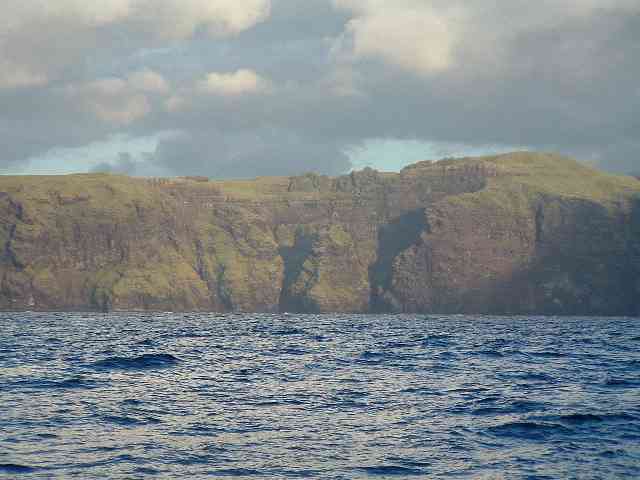
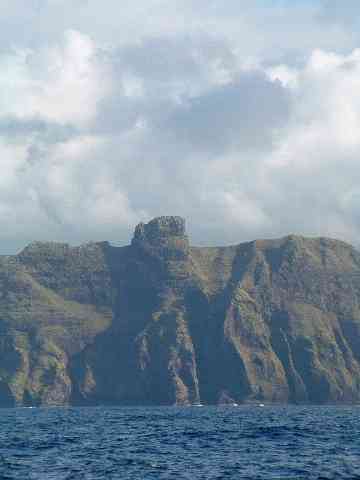
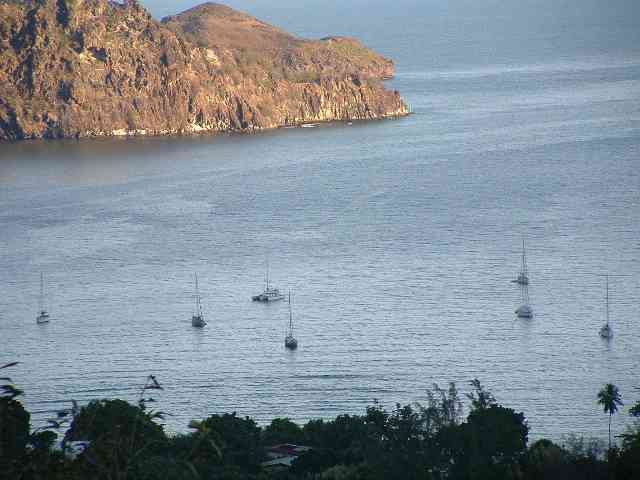
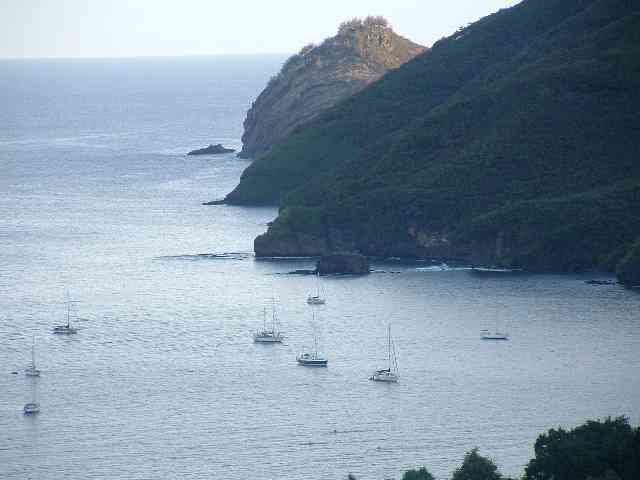
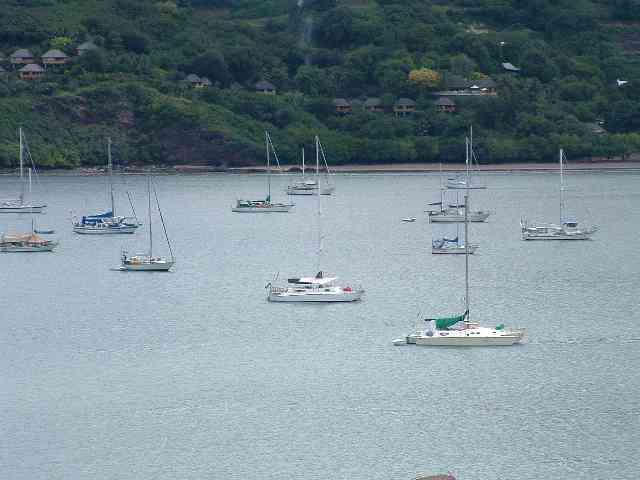
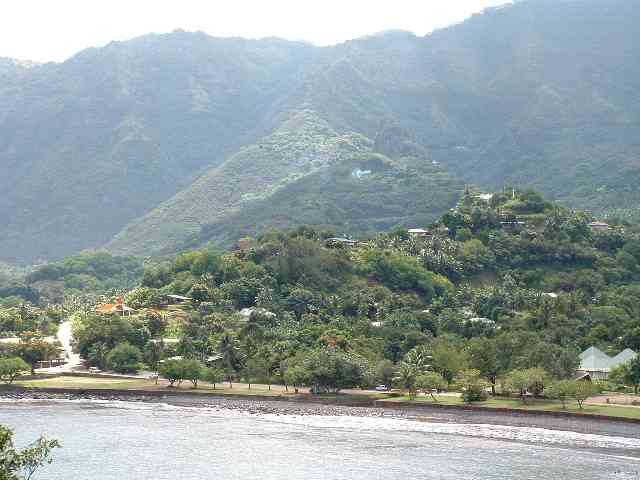
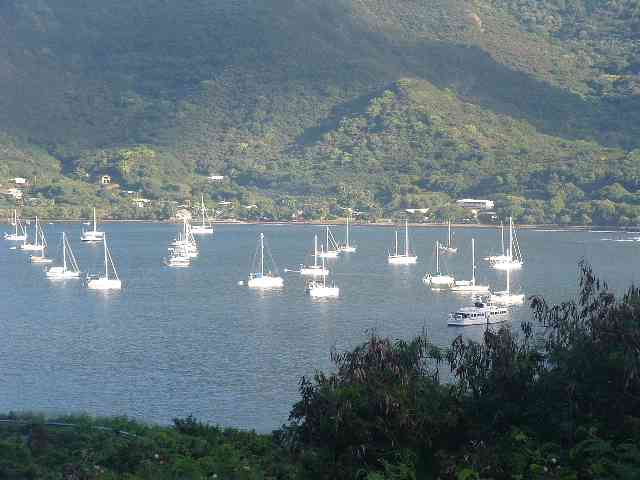
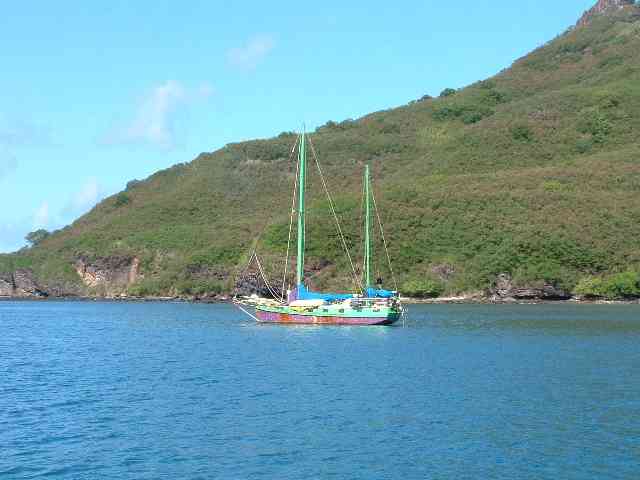
I gotta go on deck. Karryn: We arrived at Taiohae Bay sometime this morning, but I couldn't tell you exactly when. We motored from midnight on when we had squalls all around us but hardly any wind. As we approached the island, Bill had to miss out on some of the approach scenery and go sleep; since he's both the muscle and brains when we anchor, he had to be well rested. We approached the island from the east, and had to go around to the south side, with Taiohae Bay being nearly halfway across to the SW corner. As he headed down below, Bill suggested we motor close by the eastern side, do the island tour thing. I wasn't sure about this, as if the motor stopped working, the waves would carry us straight there. It might be more reasonable if there's a half mile of 30 foot depths to drop the anchor in, but the eastern side of the island is all pali, those lovely thousand-foot cliffs straight up from the water. Plus the eastern side isn't charted within two miles; when I realized I was seeing huge spumes from waves hitting the rocks at the bottom of the cliffs when we were five miles away, I decided that we were close enough. The spray was going really high, and it was enough of a thrill from our comfortable distance out. ************************** It was lovely to come into Taiohae Bay, having the swell start to die down, seeing the boats of friends already anchored at the inside end of the bay (it's over a mile deep). The island is green, lush and largely vertical with the top of the mountains shrouded in the tradewind clouds. Quite the change from Mexico. ************************** We've changed time zones to match local time, which is 2.5 hours different from Seattle's PDT. We had a great time socializing with old friends who'd arrived in Taiohae before us (even someone from our old dock at Shilshole in Seattle!), the boat is halfway cleaned up and I'm looking forward to waking up tomorrow after 8 HOURS IN BED!!! Hopefully, I will be asleep for most if not all of those hours. The boat is mostly still and, even though we arrived after the baguettes were gone, friends on another boat had one to bring to us.
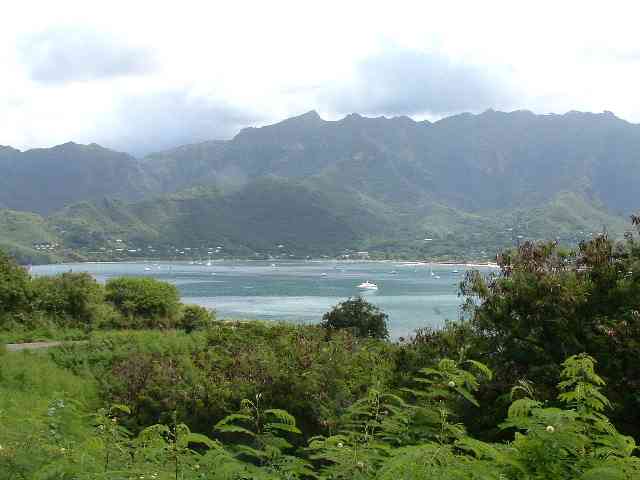
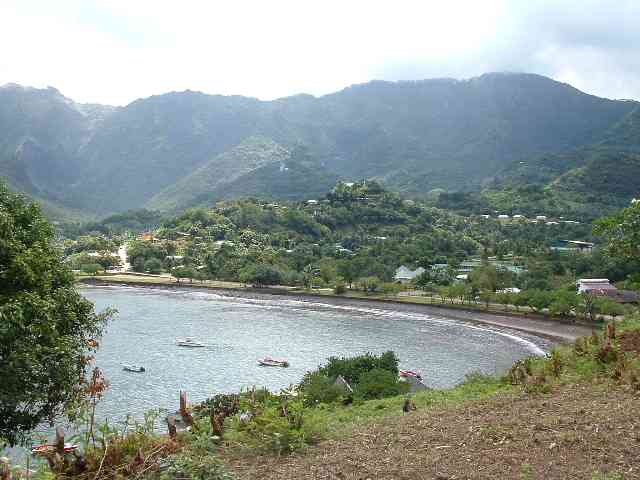
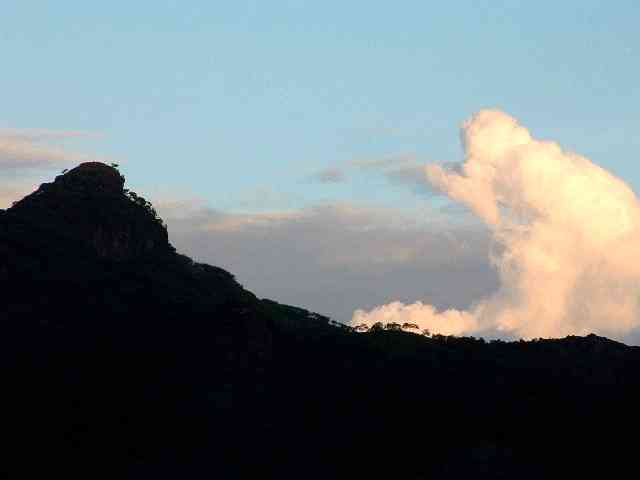
Sunday, May 22, 2005Jackson: We got into Taiohae yesterday. Mom and Dad invited a guy named Harry to dinner, and he got here in mid-evening. Somebody (probably Mom) set out Breton crackers and canned Dutch-rubbery cheese. Dad and Harry were too involved in conversation (in between the two of them and a couple who visited) that they didn't notice the hors d'oerves. I ate them all, which might explain why I felt so full after dinner. We baked two cakes and ate a mixture of rice, chicken and parcheesy sauce (parmesan cheese and some other ingredients cooked to a soup-like consistency). Mom and Dad had the same, except with the chicken missing and tofu put in its place, along with their own sauce. I have no idea whatsoever why they like that stuff. It appears to me to be a mashed and colored collection of soybeans cooked into a shapeless tasteless white paste, cut in little cubes. After dinner I opened my birthday presents. They were two books and the DVD of ‘The Incredibles,' which we got months ago but was hidden for months after watching it a couple times. After that we ate the cake, which had the bottom layer sliced off because of the consistency (Naomi and I had eaten that earlier). The cake tasted good, even though Mom warned us that some things might not be right, due to a senile thermometer and an old oven. After cake the grownups talked for hours, while I read one of the books, then went inside with Naomi and watched the movie, with about half the parts skipped. After that we went to bed. I have no idea when Harry left, although it had to be late, as it must've gotten light around 5:00am (I woke up around 5:30am) but Dad (Mom was up when we were) slept to around 8:00am and took at least one nap today. Taiohae is spectacular, with high mountains all around (the highest are on the north and northwest sides). The highest ones have a constant cloud-mist hanging around the tops. There is a waterfall in one of the valleys at the head of the bay, you can see trees silhouetted on the mountaintops against the sky, and it is grass, bushes and trees everywhere. It's quite a change from Mexico; the closest thing to this we saw was in San Carlos, on the coast of the Sonoran Desert, where there was a lot more reddish-brown mixed in.
The bay was formed from a pair of volcano calderas that the sea flooded, and there is a pair of islands/rocks at the entrance, quite originally named Sentinelle de L'Est and Sentinelle de L'Ouest (East Sentinel and West Sentinel). There is a little rocky point called Pointe Arguse on the eastern side of the bay that looks like it was the dividing line between the two calderas. There is an interesting piece of history about this place. In 1813, a foreign nation claimed the Marquesas for the first time when Captain David Porter, an American commander of a squadron of warships, anchored at Taiohae, set up a fort (Fort Collet on the eastern side of the bay) and renamed the place Madisonville after the President of the United States. Things didn't work out. Porter allied himself with the group that lived in the bay, and sent his troops against Taipivai, which Taiohae happened to be at war with. At the first battle (I think it was a beach landing) the Taipivaians, armed with wooden spears and stones, got the better of Porter's men, who were armed with muskets. It was the opposite of Napoleon's Battle of the Pyramids, where an army of Mamelukes armed with metal swords lost around six thousand men to the French, who lost about thirty. I guess the Marquesans were more experienced. Later on, Porter made an inland attack, which was more successful, but ultimately lost his war because the U.S. Congress never got interested in a bunch of unprofitable islands populated with ferocious warrior tribes with primitive weapons that could get the better of soldiers carrying firearms. Our crossing was okay (Dad kept going on about how it was the best sailing we'd ever see; he was probably right). We had two pods of spinner dolphins accompany us at various points (it might have been three pods or only one). They were large pods, with at least fifty members. They were dappled and had white nose tips, and were small compared to the other dolphins we've seen. The first pod we saw was fishing, and followed the fish away from us, then returned from the same direction they'd left the next day.
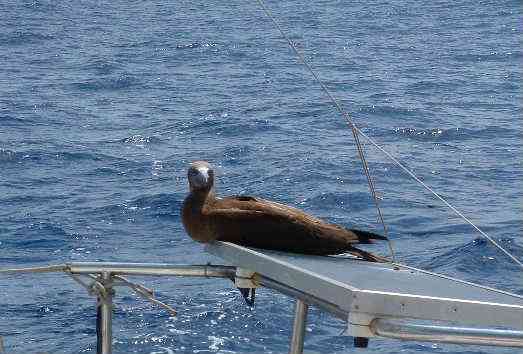
A few days after that episode another booby pooped on Naomi while circling the boat. She was furious. Crossing the ITIZ (InterTropical Inconvience Zone) we saw spectacular clouds and a lot of squalls. We had a smaller version of the Zone later on, and got more squalls. We approached Nuku Hiva from the northeast, and saw the pinnacle rock at the end of the peninsula that ends at Cap Tikapo. We passed through a rip tide full of coconuts, sticks, and other debris south of the cape. On the last few miles I steered, watching for floating logs. We saw a good-sized sea cave (I think it was Ekamako cave, a dive site) and lots of silhouetted trees and rocky, black cliffs. Coming in we saw that Sentinelle de L'Est had a lot of bunches of long grass that looked like bushes, and two palm trees on it. When we got into the bay's protected water, we needed to put away the genoa and haul the anchor out of the locker, so we turned off the engine and stayed in the middle of the bay for a while off Pointe Arguse. Then Dad toured the bay, and then toured the neighborhood (all the cruisers), stopping the boat a few feet off other boats to have conversations with the inhabitants. Then we anchored, culminating a three-thousand-mile voyage. +++++++++++++++++++++++++++++ Karryn: Last night Harry, a friend from Seattle whose boat was a few slips down on D dock, came over for dinner and shared in Jackson's birthday celebration. All the boats with kids cleared out yesterday morning; we saw many of them motoring out as we were motoring in. I don't think Jackson minded, as he generally prefers family celebrations to those with a bunch of kids he doesn't know. So I had to empty the oven, usually full of electronic items being kept safe from lightning (including the PC I'm writing on), and discovered that our oven thermometer no longer works. Or, more precisely, it only worked going up, and then got stuck at the highest temperature the oven got to when I preheated it. After that, I played a little game to see if I could keep the oven at the right temperature for the two cake layers (only one fits in the oven at a time). To add to the adventure, I had to crack open ten eggs to find three good ones, the other seven having spoiled. Fortunately, the cake and the frosting were chocolate and reasonably tasty, if a bit goopy in the center, and we still have the second layer to eat tonight. Today was mostly a lazy day -- several naps, each followed up by a pot of coffee. The bay is beautiful, and it was lovely to be slow and just enjoy the scenery. The clouds go by and cool things down. This is good, nicely pleasant, as the bay is very sheltered from the current wind direction (more easterly) and it's amazingly hot and sweaty. Everything is closed on Sundays and Saturday afternoons, so we had an excuse not to be too busy. Tomorrow we don't, and since everything opens early and then closes between 11:30am and 2-3pm, we have to get going early. Since sunrise is before 6am local time, it shouldn't be too hard. I suspect we'll eat dinner, watch a bit of 'The Incredibles' (Naomi's gift to Jackson, although we watched it before we left and then he put it away until now) and then fall asleep. It's raining right now, and Jackson mentioned how much nicer downpours are when one doesn't have to be out in them! It turns out the visa situation is more flexible and random than we thought. Here at Taiohae many people have gotten 90-day visas, as opposed to the past practice of getting 30 days and then having a month to get to Papeete to request an extension that isn't always granted. People who arrived with previously obtained 90-day visas don't have to post the $1000 per person bond. Conversely, some people checking into Hiva Oa, the other entry island, have gotten 30-day visas with no possibility of extension. So we'll go in tomorrow, expecting to post a bond (it will be somewhere between 3 and 4 thousand dollars -- the approximate amount of one-way airfare back to the U.S. for all of us) and hoping to get 90-day visas here. I plan on bringing the part of Bob's book and photos of their trip here that Yvonne put together, and explain that the reason we want 90 days is because Bill wants to take his family to the same places he went 35 years ago.
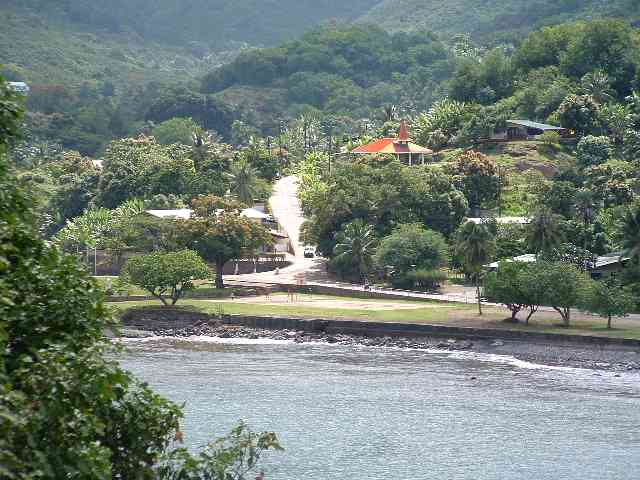
Sunday, May 29, 2005Bill: It's a rainy day in Taiohae. We all got up early to go to church this morning, but the others didn't feel up to the trek and I went for a wilderness hike alone. I'd been a little challenged to find a nice, dirt trail for walking (the roads here are now paved), but had located a potential path I wanted to explore. It led me out along the east side of the bay, out toward the cliffs that line the entrance. It started to rain, so I sat down for a while above one of the cliffs, under a canopy of small trees. The return home was a bit of an experience. The path I'd come down was at the end of an overgrown two-rut road, which then turned into a single lane along a wall of rock. The rock, now slippery, presented a challenge to find the high-friction surfaces; the plants, now sopping wet, presented a shower in flora. Taiohae is much as I remember it, grown for the thirty-five years of intervening time. There appear to be about twice as many roofs, the town now extending to the west side of the bay. The scale and sensation of the place is reminiscent of Eastsound on Orcas Island. The bays are similarly sized and shaped, both about a mile wide, with towns at the upper end. Eastsound, though, is between the two high lobes of Orcas and open at the north end, creating an anchor-threatening venturi effect with the wind; Taiohae is high all around, creating a sheltered, enclosed feel. The town, with a population of 1700, is one of the three largest in the Marquesas, a fact that led to a somewhat cosmopolitan expectation on my part. Not so, it appears; this place looks pretty sleepy. Four grocery stores, a hardware store, a bank, a fueling station at the commercial dock, a number of restaurants spread around the bay and a hotel with bungalows up on the hillside on the western side of the bay. Thirty-five years ago, the place had a blue grocery store. Still there, a bit modified. I felt like I recognized the old guy behind the counter. One thing's a little odd, though; there are a fair number of new-looking cars, mostly SUV's, off-road sorts of affairs. Oh, and the paved roads. Quite remarkable, in a way, all the main roads are paved. I had to search a little to find a nice stretch of dirt to walk on. A few days after we got here last week, Jackson and I went for a hike, a gnarly run at Taiohae's ugliest hill. We hiked upward until twilight threatened, and then started our descent. About two thirds of the way down, we ran into a very nice man, Ishmael Otto, who showered us with fruit. On our way up the hill I'd spotted a tree full of pomplemousse fruit, grapefruit on steroids, and on the way down Mr. Otto, a thirty-one- year-old father of two, was standing in front of it. An ever-enterprising soul, I asked in a bit of French, but mostly in sign language, if I could have a fruit. "No." he said in English, "They're not ripe?" He then led us to another tree, this one with ripe fruit. While he gathered pomplemouss, he instructed Jackson and me to gather limes off a nearby tree. After that, he had us get into the back of his four-passenger pickup, drove us the remaining distance down the hill, then up to his house, and proceeded to shower us with bananas and a large and very tasty morsel that should have been named Hogtestical Fruit. The whole experience punctuated with Ishmael's "God Provides" commentary as fruit fell from the trees. He said he wanted to maintain his English skills, and invited us back for fruit and conversation in the future, then gave us a ride down to the dinghy dock. Pretty wild. I came away touched. We also met some interesting folks on another Jim Brown trimaran, a Manta 41 called Nereis, out of Berkeley. Quite the lively dinner conversation we had with Jacques and Cheryl. These folks are pretty alternative, having lived in communes and that sort of thing. He is a Frenchman and a gardener, she a tax attorney. One of the things we discussed was what it would be like to hang out for a few years in a place like Taiohae. Cheryl's comment: intellectual wasteland. We discussed this further, and came up with a partial list of what you'd want to have access to, culturally: - A library - A college - A theater Cheryl also commented that she'd want the place to have a café ethic, where folks congregate in search of conversation. For a little while now I've been thinking it might be interesting to live on an island for a period, and one of the things we've discussed is doing this before returning to the US. One of our issues is that we live on a boat and are exposed to weather hazards, the most extreme of which are hurricanes. There actually aren't that many islands in the Pacific that have the features we'd be looking for – English-speaking, hurricane-free, protected anchorages, etc. Two of the few are in Eastern Micronesia, just about as far from anything as you can be. The islands of Kosrae and Pohnpei are located just north of the equator, about midway between Hawaii and the Phillipines, in the middle of a vast, mostly empty expanse of ocean, the only two high islands in a region dominated by atolls. Pohnpei, the larger of the two, has a population of about 35,000, fifteen times higher than Nuka Hiva with about the same land area. I looked at a travel guide on Pohnpei and its main town, Kolonia, appears to have these cultural landmarks – a library, a college, a theater. I'm kinda wondering if there's an American expatriate community there, what its flavor is. For example, I can imagine retired military personnel from Guam or Peace Corps hippies. I suspect there aren't too many yachties given that it isn't located along any of the common cruising routes. When we visit Ishmael again, I want to look over his house more carefully. It was very new, three weeks old, he said, so will reflect current thinking on spaces and materials. When I ponder my life-on-an-island fantasy, it seems like it would be neat to have the option of sleeping on the beach some of the time, a place to store bikes with a view of the boat. We'll see how this works out.
Tuesday, May 31Karryn: It has rained off and on all day. You've seen pictures of those rows of little white fluffy tradewind clouds; now imagine them a bit bigger, a lot darker and with rain and a bit of wind underneath. We've had those since sometime last night, and today I think it has rained about once an hour.
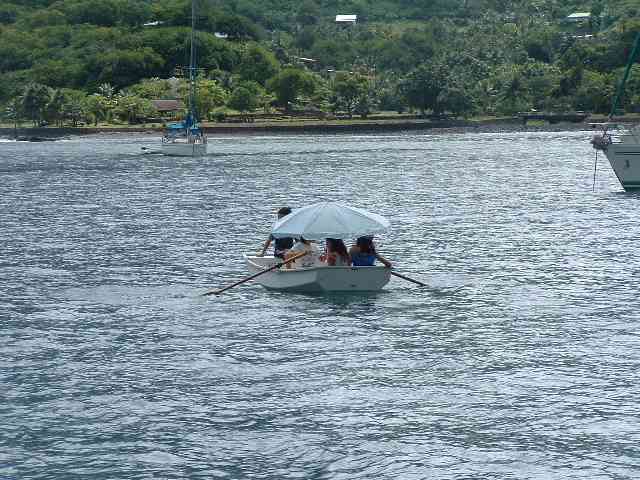
Each time it rains, the wind comes in from a new direction and we've been treated to differing views out the window, mostly of boats with green foliage backgrounds. Bill went for a walk this morning and came back soaked; he opened the forward hatch (I had left it shut because of the rain) but forgot that he had opened it until things had gotten wet up front – now, inside it's humid and steamy. As long as I sit with a fan going, it's pleasant; I'm not looking forward to cooking dinner, though. We have gotten to know the town a bit; there are about 2000 people here in Taiohae, out of maybe a total of 2400 on Nuka Hiva. I went to a Tahitian dance class, which was an incredible workout. I had brought a towel and a change of clothes, and I showered afterwards in the restrooms on the pier (quai) in very cold water and it was heavenly. Then I immediately rinsed out the clothes I had danced in, as they were drenched in sweat. My French is coming back, at least enough for basics, but the gendarmes are harder to understand. One particular guy in particular, a dark-haired Frenchman with a goatee, seems to take great delight in confounding me. At least he's happy, though (Bill says he's flirting with me), as they are the ones who determine the visa length we'll get. We had problems with credit cards when paying the bond, so we haven't finished checking in; we think we'll get 90 days and therefore have plenty of time here, but we can't finish the process until tomorrow. Bill and Jackson met one of the locals who sent them home with a bunch of fruit. The local grapefruit are these enormous, green-yellow things called pomplemouss, much sweeter and milder than the ones from the states. The bananas are small but good and we once again have limes to squeeze into our drinking water. We also bought plantains, which are like bananas but require cooking. We cooked them in water, and they taste like a cross between bananas and sweet potatoes. My cookbook says they can be used in a recipe for candied sweet potatoes, but I can't see how one could eat them any sweeter than they are naturally. We think we'll stick to exploring this island over the next two or three weeks. We might also check out Ua Pou, which is about 25 miles away. We'd like to leave here so we arrive in Papeete with about a month left on our visa (if we get the 90 days). We've also been told that it's possible to get the 90 days extended another 90 days; we'll see if that works out. Not much else happening. I have laundry to do, the kids are catching up on schoolwork, various boat chores await our attention... and the view is always terrific, even when it's raining.
|
|
Last
Updated: 11/28/16 |
| Web Curator |