| HOME | Current Position Report | Logs & Stories | Photos | People | The Boat | Contact Us |
|
| |||||||
| |||||||
 In this section Logs Index |
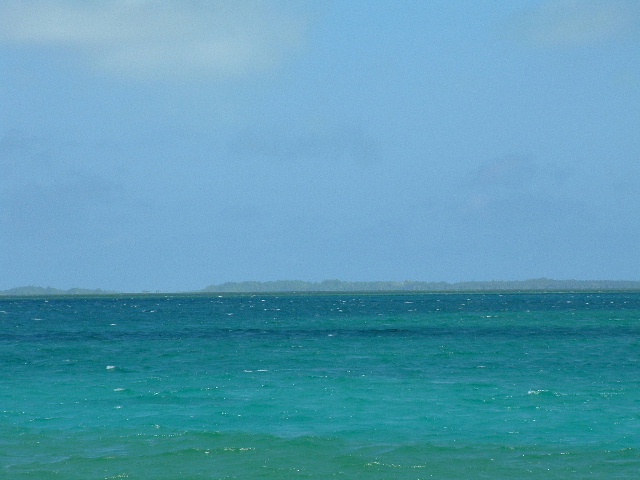
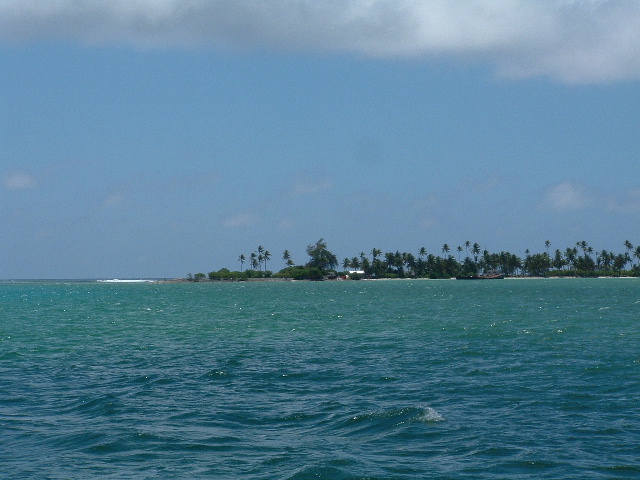
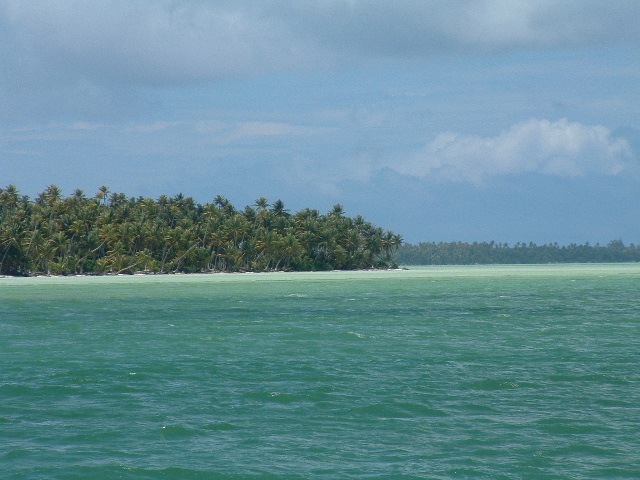
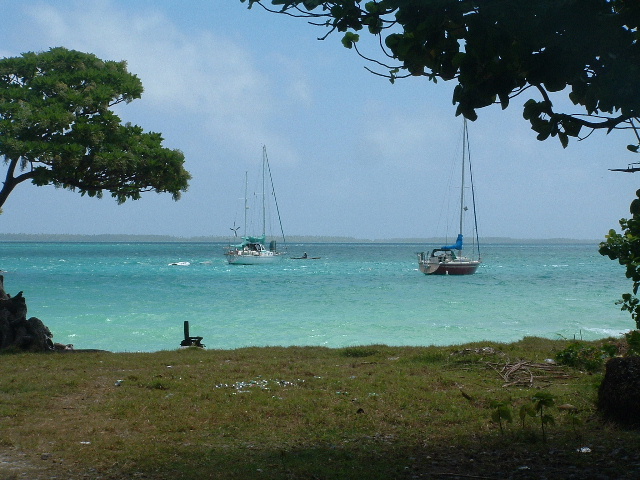
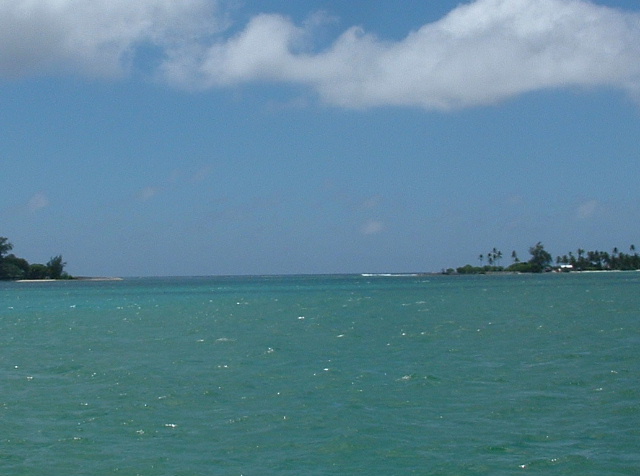
Logs & Stories - February 2006Fanning IslandFebruary 1, 2006 -- part 1 Bill: We're here at scenic Fanning Island now, a gorgeous spot. The place actually has a more real, more appropriate Kiribati name: Tabuaeran Atoll. Remote and exotic, well off the beaten path in spite of its proximity to Hawaii, 1100 miles to the north. This region, the Line Islands, is one of the more isolated areas of the Pacific, just a few scattered atolls with an aggregate population of around ten thousand folks. Christmas Island, in spite of being well known -- made famous by the Andrews Sisters' 'Christmas on Christmas Island', and British nuclear testing done there in the middle of the last century -- was actually pretty remote, too, until now about the most remote place we've spent any time at. [Editor's Note: There are actually two Christmas Islands; the other one is in the Indian Ocean between Australia and Indonesia, and is a colony of Australia, due no doubt to its phosphate deposits.] Tabuaeran is REALLY remote. The supply boat hasn't made it here in eight months, and there are no airplanes coming into the now overgrown landing field. We're told the island is running seriously short on basic things like antibiotics, soap, laundry detergent, thread, lighters, gasoline, tobacco and beer. The only supplies are coming in via a cruise ship operated by Norwegian Cruise Lines, which lands 1500 tourists for an afternoon every other week, briefly doubling the island's population. At this point we've only been here on Tabuaeran a couple of days. The passage from Christmas was really wonderful: a day of blissful reaching in medium air conditions. Kind'a like our passage from Mexico to the Marquesas, only with a small fraction of the duration. Coming into the pass here was pretty straightforward, too. We timed the passage so we'd arrive slightly before slack water, and entered the pass at mid-day with about a knot and a half of current against us. A couple of months back, we came into Suwarrow in the northern Cook Islands in similar tidal circumstances, but the pass and the lagoon were trickier, having more reefs to run into. Also, at that time, a big nasty squall moved in and obscured all the underwater obstacles (yikes!). Here, a tiny squall passed through first, and then we were able to enter with poor visibility, shallow and hard coral patches difficult if not impossible to spot. Under the noon-day sun, entering the lagoon was visually spectacular -- fringed by a band of tall green palm trees hovering over a white line of coral beach, the sparkling, light green saltwater lake extended out three miles toward the atoll's far shore, a giant blue-green gem under a bright sun.
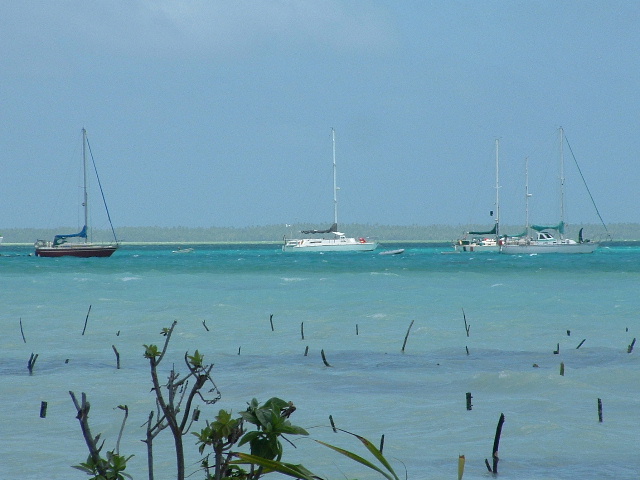
February 1, 2006 -- part 2 Bill: As we came though Tabuaeran's pass and into the lagoon, looking to the right we found three other yachts.
One, Freya, we'd met at Christmas a month earlier. Aboard was Bjarne, a forty-year-old, youthfully handsome and athletic engineer from Victoria. It turns out we'd just missed seeing his wife, Barb -- she passed by us in darkness the night before returning to Christmas aboard another boat, on her way to the airport and a flight back to Canada to be with her father during an upcoming heart surgery. Giva, the second boat, is owned by a French Canadian couple, Valois and Gigi, who'd spent a decade in Hawaii. The boat's name interestingly comes from the concatenation of their names, her name first. Seems the right way to have done things since 'Vagi' inspires other imagery. During one Sunday afternoon potluck, after Val and I had consumed a few glasses of wine, I asked him about the name of his boat: How did they decide whose name should come first? He laughed hard and claimed it could have been even more interesting since their last name is Nadeau. We hardly know them at this point, but it appears they've done a nice job integrating into the community. Gigi has been giving quilting lessons to two of the more on-the-ball women on the island, one the island's nurse (who, we're told, has almost no access to medications), and one of the island's junior high school teachers.
The third boat, Ilobaby, is perhaps the most interesting. It's owned by a Frenchman named Bruno, an on-and-off island inhabitant for the last two decades. Bruno's inspiration for his life is Bernard Moitessier, one of the world's most highly regarded singlehanded sailors, whom he met in France when he was fifteen, and I met in Tahiti when I was ten. Among Bernard's various accomplishments was to sail around the world one and a half times, non-stop and alone. He was competing in the first Around the World Singlehanded Race, held in 1968-9, and was winning but decided that, rather than complete the passage going north through the Atlantic back to France, he'd rather continue on to Tahiti. An enormous accomplishment, well before GPS, watermakers, roller-furling, LED lighting and numerous other navigational, safety and energy management devices that we take for granted today. Bernard died in the mid-90's but has been a frequent part of my life because of my family's relationship with his English translator, William Rodarmor (William was our crew aboard 'Soceress' for about two months when I was ten, and has been a recurring visitor in my parents' home ever since; I think of him as being one of my uncles). I recently read something about the end of Bernard's life, when he was making an effort to impact the problem of nuclear proliferation (I read a couple of years ago that the world has something like 28,000 of these devices, about a third owned by the US; seems a few more than necessary. Anyway, Bernard made a comment about it in 'Tamata and the Alliance', his last book: "We may as well admit that the human species is led by men who are half crazy. Let's hope that women will some day rouse themselves to preserve Life while waiting for Intelligence to awaken within the bosom of humanity." Quite the thought; I haven't seen it expressed elsewhere.
February 3, 2006 Bill: Tabuaeran Atoll is actually a fairly unusual atoll. I suspect the majority of islands in the Pacific are atolls, rings of land and reef that are the living coral remnants of high islands that existed in their place eons ago. I've studied charts of dozens of atoll lagoons and most show deep basins, commonly with anchorage area depths in the 80-120 foot range, challenging for a number of reasons including requiring one to put out nearly 300 feet of chain to be safely secured. Christmas Island and Tabuaeran both have very shallow lagoons; most of Christmas is on the order of a meter deep, too shallow to transit, but here at Tabuaeran there is a square mile of area that has depths between ten and forty feet, making a large expanse for reasonable anchoring. Also, the atoll is fairly small, so when you're anchored at the downwind side of the lagoon the fetch doesn't generate waves that are monstrous. Many of the atolls in eastern Micronesia (where the Gilbert, Marshall and Caroline islands are located) are much larger, as much as thirty miles across, and I'm told that being on the downwind side can be excessively bouncy. Even so, this place has been anything but calm.
We're anchored very close to the pass. Based on other atoll charts I've reviewed, the pass here is one of the easier ones to enter and exit. It's short, straight, reasonably wide and free of coral heads. Once you enter, the bottom shallows to about fifteen feet and there are a variety of places to anchor. The current can be an issue, though. The tidal range is only around two feet, but during maximum flow the current runs at about five knots. Not horrible for an atoll, mind you -- according to the guidebooks, Canton Atoll, west of here in the Phoenix Islands, has a current of about ten knots and slack water only lasts about fifteen minutes.
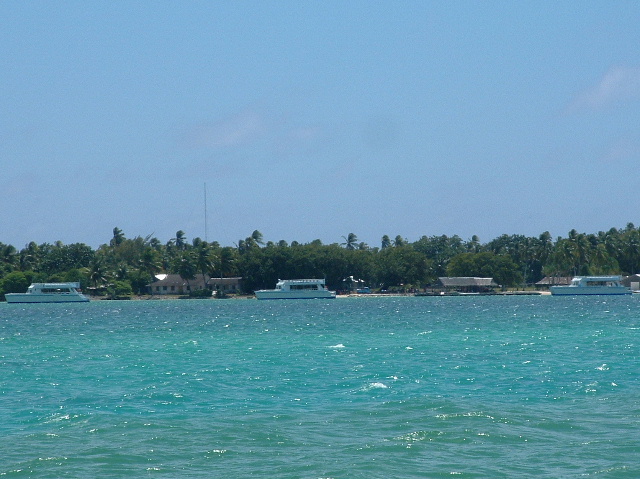
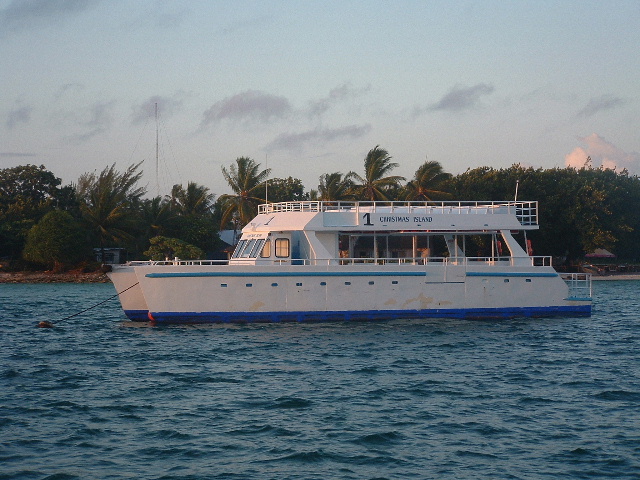
I'm generally paranoid about the possibly of entering a lagoon under engine power and then having a problem that makes the diesel inoperable; we tend to only go places that can be exited under sail. This place qualifies. If we had an engine failure, we'd be able to pull out and make the transit to Tahiti, Hawaii, or Samoa for parts and repairs (all about a thousand miles away). On the beach immediately inside of us, on the point projecting into the pass, is the Norwegian Cruise Lines shore side facility. An odd place here on Tabuaeran, it looks like a park in the US -- small, neat buildings, a mown lawn. Along the water in front of it, there is a stretch of beach and a wooden dock. Anchored a short distance into the lagoon are three NCL power catamarans, each perhaps fifty feet long, painted white with blue trim, neat and well kept.
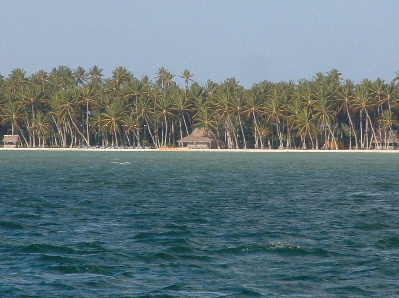
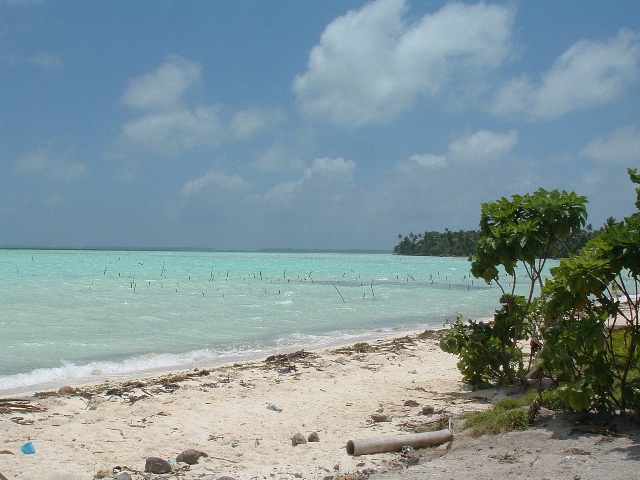
Surveying the rest of the beach and lagoon outside our immediate area, you see nothing but water, beach and palm trees -- no anchored boats, no buildings. A pristine, gorgeous lagoon.
February 5, 2006 -- part 1 Bill: At this time of year, Tabuaeran sits under the southern edge of the Doldrums, now typically called the Intertropical Convergence Zone or ITCZ, the band where southern hemisphere southeasterly tradewinds converge with northern hemisphere northeasterly tradewinds. Because of the Earth's rotation, winds at the equator in the middle of the Pacific have an easterly tendency, offset by westerly winds in the high latitudes and creating two great spirals of wind, one in the southern hemisphere and another in the northern hemisphere, each rotating around a centrally located high pressure zone.
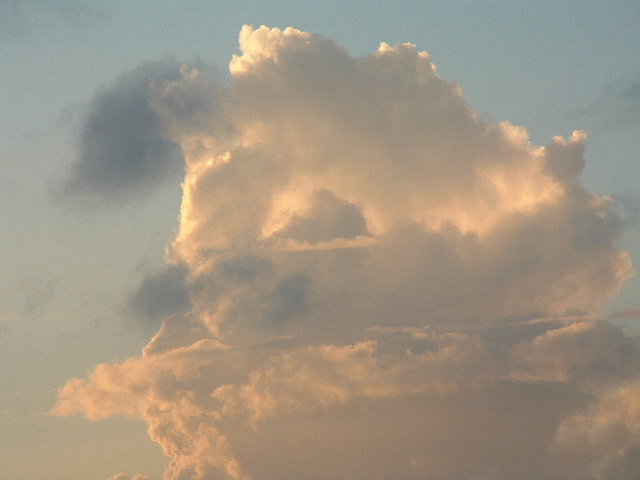
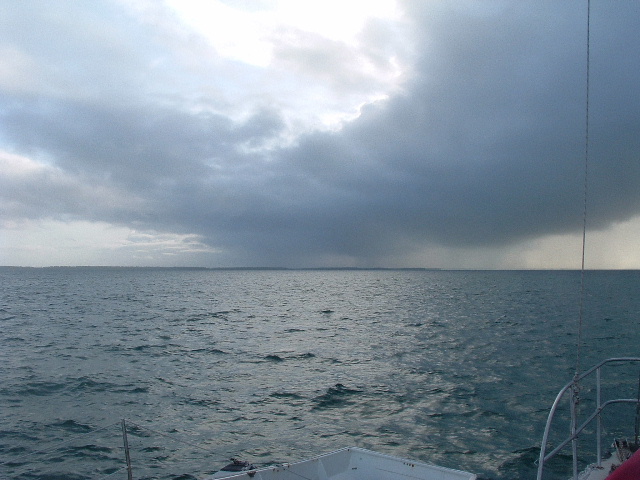
This convergence zone, the ITCZ, is a moving band of air that can be challenging for sailors. It is characterized by frustrating light winds and terrorizing squalls. The squalls we experienced during our transit through the Doldrums aboard Soceress when I was ten made such an impact on my father that he shortened Seafire's boom by four feet and had a main built with only a single reef far up the sail's luff, enabling him to radically shorten an already small sail in one fell swoop. For years I hated this main because in Puget Sound's light winds it made Seafire undercanvassed, but after using it in Mexico I concluded that the helm was far more balanced than with our larger racing main, enabling the windvane and autopilot to steer more easily. We had a second, less radical reef added, though. For an islander, the Doldrums seem a blessing. Christmas Island lies south of the normal region, out of the area of squalls, receives little rainfall and is known for droughts. When Captain Cook came to the place on Christmas Eve of 1777, he found a barren, desolate island with only a few coconut trees. I recall reading somewhere that Tabuaeran gets around 180 inches of rain, and so far my experience confirms this. It's rained nearly every day, some days all day. Plus, unexpectedly, the wind blows constantly at about 20 knots, just as it did at Christmas Island. When we came here we expected to be greeted by a placid, clear lagoon, but so far the water has been murky and rough, a little challenging to launch and board a dinghy, a little creepy to swim in. We've been told, though, that these conditions are only a characteristic of winter, with lessening rain, lighter wind and clearer water reappearing as we move into spring.
On the good side, though, the wind power here has treated us to an energy abundance; we've been able to have pretty much unlimited use of both the PC and the watermaker without having to run the diesel to generate power. Plus, should our watermakers fail, we'd have a supply of water falling from the sky.
|
| Last
Updated: 11/28/16 |
| Web Curator |